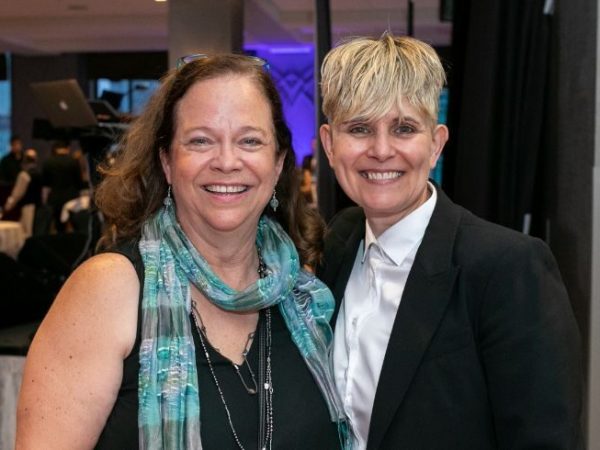
Photo caption: Trish Silvester-Lee (left) with Dr. Jackie Whittaker (right)
Arthritis Patient Advisory Board Member Spotlight: Trish Silvester-Lee
The Arthritis Patient Advisory Board (APAB) is comprised of volunteer advocates with arthritis who bring personal lived experience and arthritis knowledge to research decision making at Arthritis Research Canada. By sharing their perspectives, APAB members ensure that the voices of people living with arthritis help shape the work we do.
One of these members is Trish Silvester-Lee, has been part of APAB since 2015. Trish has been involved in the arthritis community over the years as an educator, volunteer, and event planner.
1. Trish, can you tell us a bit about yourself and your connection to arthritis?
I tore my anterior cruciate ligament (ACL) during a skiing accident when I was 17. At the age of 21, I had knee reconstructive surgery. A few years later, I started to have a lot of knee pain and it was starting to impact my life, especially as an athlete. My orthopedic surgeon told me I could develop arthritis in my knee. I didn’t understand this was possible, because I thought arthritis was an elderly person’s disease and the only people I knew who had arthritis were older, like my grandmother.
After I was diagnosed with osteoarthritis in my early 30s, I got pregnant, and that wreaked havoc on my joints. My arthritis symptoms, especially the pain, got worse after I gave birth to my son. At that point, I was doing everything to educate myself and prevent further damage to my knee. I was actually working for The Arthritis Society as an education manager at that time and had access to classes, workshops and public forums. I was proactive in learning to manage my osteoarthritis, modify my daily routine and maintain my quality of life.
However, the pain and decreased mobility kept getting worse and I eventually had a total knee replacement. I had some post-op complications, mainly arthrofibrosis, which is a build up of scar tissue formation restricting knee joint movement. I underwent a second surgery called a manipulation under anesthesia. I’m now 10 years post-op and have focused on major lifestyle changes to protect my knee. I am now dealing with compensatory osteoarthritis in my other knee and hip.
2. What motivated you to join Arthritis Research Canada’s Patient Advisory Board?
I was heavily involved with the arthritis community: with the Canadian Orthopedic Foundation and The Arthritis Society. I attended several of Arthritis Research Canada’s “Round Table on Arthritis Research” (ROAR) events. I was approached by several APAB members about joining, and came onboard in 2015.
As a patient partner, I joined Dr. Linda Li’s ‘Monitor OA’ project. Dr. Li was my physiotherapist at Mary Pack Arthritis Centre before my knee replacement, so working with her was neat. I was also involved with the Dr Diane Lacaille’s ‘Making It Work’ project, since I was trying to find balance between managing my osteoarthritis while working full time.
As the first patient partner to participate in the Arthritis Research Education Series, I spoke about living with osteoarthritis, being diagnosed as a young adult, and the challenges of raising a child while managing my osteoarthritis. I’m currently working with Dr. Jackie Whittaker on the ‘Stop OsteoARthritis’ (SOAR) project, to see whether we can prevent osteoarthritis after an ACL injury and surgery. I’ve been involved with the SOAR project since the beginning in 2019.
I am also working with Dr. Derin Karacabeyli on a research project that studies whether semaglutide is safe and effective for people with inflammatory arthritis and type 2 diabetes. In addition, I am working with Dr. Mary De Vera on a project measuring medication adherence across chronic disease areas.
3. What does being part of APAB mean to you personally?
When I first started on APAB, I was passionate about helping other people. But I believe that all of the members also want to be part of APAB because we might learn something that helps us as well.
We all have different forms of arthritis with varying symptoms, and are in different phases of our lives. I find that I learn a lot from each of the different members of APAB. I also learn from working with our scientists, since they really value our opinion.
When I’m around people with arthritis and they understand what I’m going through, I don’t have to explain. APAB members support each other. We listen to each other and we get it. We don’t have to justify why we’re saying “no” to a social event or activity.
4. Why do you think patient perspectives are important in shaping arthritis research?
Researchers can have great ideas for a research project and in collaboration with patient partners who share our lived experiences to help make the research relevant. The researchers may reshape their studies when we share how that project will impact our lives.
I never liked to share my story before sharing it with Arthritis Research Canada, as I didn’t want arthritis to label me. It’s part of me, but it’s not who I am. However, I share it now because it’s important to educate people and help them understand what we go through daily.
5. What are you most excited or hopeful about when it comes to arthritis research?
I’m hopeful to see a cure for arthritis one day.
Years ago, we never thought that arthritis would go into remission, and now it’s more of an invisible disease. It’s interesting to see how far we’ve come in the last 5 to 10 years.
6. What’s one thing you wish more people understood about living with arthritis?
I wish more people understood its unpredictability. Every day is different, and each day brings different arthritis symptoms and challenges.
I’m trying to educate people to be more compassionate and empathetic. I’ve used visual aids to share what I’m going through. For example, I’ve asked people without arthritis to wear ski gloves to try to button a shirt to experience how difficult it is and illustrate the challenges we live with.
7. What are some things you like to do in your free time?
I love gardening, scrapbooking our family memories, travelling and going for walks. I hope to get back into golfing. My family lives in the Okanagan, so road trips there are a priority. Exercise is important for my quality of life and keeping my arthritis symptoms under control. I have a routine of physiotherapy, massage therapy, personal training (which includes strength training) and daily deep water running.