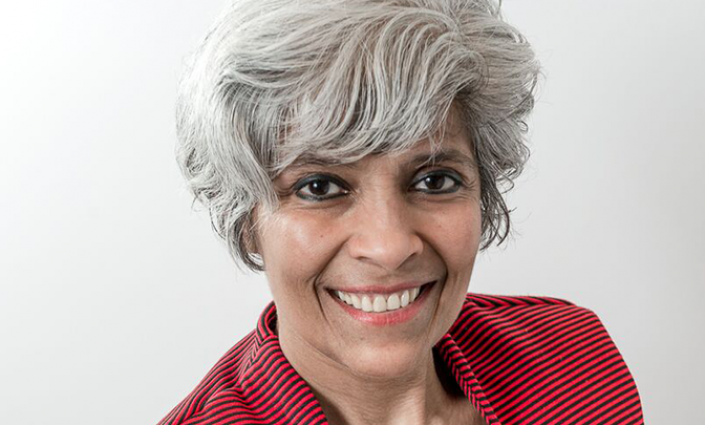
The Arthritis Patient Advisory Board (APAB) is comprised of volunteer advocates with arthritis who bring personal lived experience and arthritis knowledge to research decision making at Arthritis Research Canada. By sharing their perspectives, APAB members ensure that the voices of people living with arthritis help shape the work we do.
One of these members is Louella Sequeira, who has been part of APAB since 2018 and has lived for Raynaud’s for over two decades. Louella’s heart for her community inspires her to give back.
Louella, can you tell us a bit about yourself and your connection to arthritis?
I was diagnosed in 1999 with Raynaud’s. I had weird symptoms, such as always feeling cold in my hands and feet. I didn’t know that Raynaud’s was under the umbrella of arthritis diseases. I only learned that over time as I began to see my rheumatologist, Dr. John Esdaile. That was the start of my journey, and I had to learn how to manage my disease and its symptoms. It got progressively worse over time so I had to adapt to accommodate the disease.
What motivated you to join Arthritis Research Canada’s Patient Advisory Board?
Dr. Esdaile was my rheumatologist at the beginning, but then years went by and we lost touch. We later reconnected and he told me about Arthritis Research Canada. I asked him if I could help the organization or its efforts in any way.
I started by volunteering for the organization’s gala, and that was where I first learned about APAB. I spoke to APAB member Shanon McQuitty, was recruiting new members at the time, and she introduced me to the group and their work.
What does being part of APAB mean to you personally?
It means a lot. I value the experiences and the knowledge that each member brings. There are so many different types of arthritis. People with all ages have it, and there are varying severities of the disease. I don’t think I’ve seen a common thread or uniform experience with arthritis within our group. There’s a vast difference in how arthritis exhibits itself in different people.
The scientific discoveries I’ve learned about are mind-blowing, and I love learning about them. I always want to help and be of service to others. So, I offer to support my fellow members and our scientists whenever I can.
Why do you think patient perspectives are important in shaping arthritis research?
I learned more from the group itself such that patient voices and experiences with arthritis are so varied and nuanced. Patient perspectives are significant and never textbook.
Each person has a different disease journey, from the medications they are taking and the symptoms they’re experiencing. I don’t think a scientist could get a handle of all the different patient profiles themselves. By asking many people questions, they’re making their research richer.
What are you most excited or hopeful about when it comes to arthritis research?
I’m excited on where it might go in the future, especially with artificial intelligence (AI). The application of AI in the medical field would be amazing. I’ve been working in the IT field for more than 40 years, and its growth has been exponential. It’s accumulating vast amounts of knowledge, processing power, and accuracy, and it’s also a self-sustaining model. We’ve barely cracked the surface of what AI can do in the medical field, and what it can do for people with arthritis.
What other things are you involved in?
In addition to APAB, I’ve also been involved in hosting and helping a lot of Ukrainian newcomer families. Women and children are trying to get out of Ukraine, while the men are defending the country. We’ve hosted about five different families. They need lots of support, such as help with writing resumes, finding jobs, and networking. One of the women that I helped actually worked with Arthritis Research Canada as part of the practicum for her master’s program.
They’re like family to me now. With the last family we hosted, a woman came to Canada with her child, and she was also eight months pregnant. I connected her with a maternity clinic at Lionsgate Hospital, so she was able to receive continual care.
What’s one thing you wish more people understood about living with arthritis?
I wish that more people understood its complexities. Every day can be so different, especially for people living with a more severe form of arthritis. I want people to be more understanding and accommodating of people with arthritis.
I’m just starting to understand the different types of arthritis and all of the terminology involved with the disease. I wouldn’t mind having an arthritis dictionary to help me make sense of it all!
What are some things you like to do in your free time?
I like to exercise. I’m also very social and love getting together with other APAB members. I also love meeting with the Ukrainian families we’re supporting, and meeting other newcomers to Canada as well.
I always liked working with kids and wanted to be pediatrician growing up, but went on to do IT as my career path. I now volunteer at Vancouver General Hospital with their Cuddle Visits program, which offers emotional support program for new mothers who are at risk for postpartum depression. I get to cuddle with newborn babies and connect with these mothers, which is amazing.
I ended up getting another bachelor’s degree in education and I now teach classes. I love supporting kids as they learn and grow.